
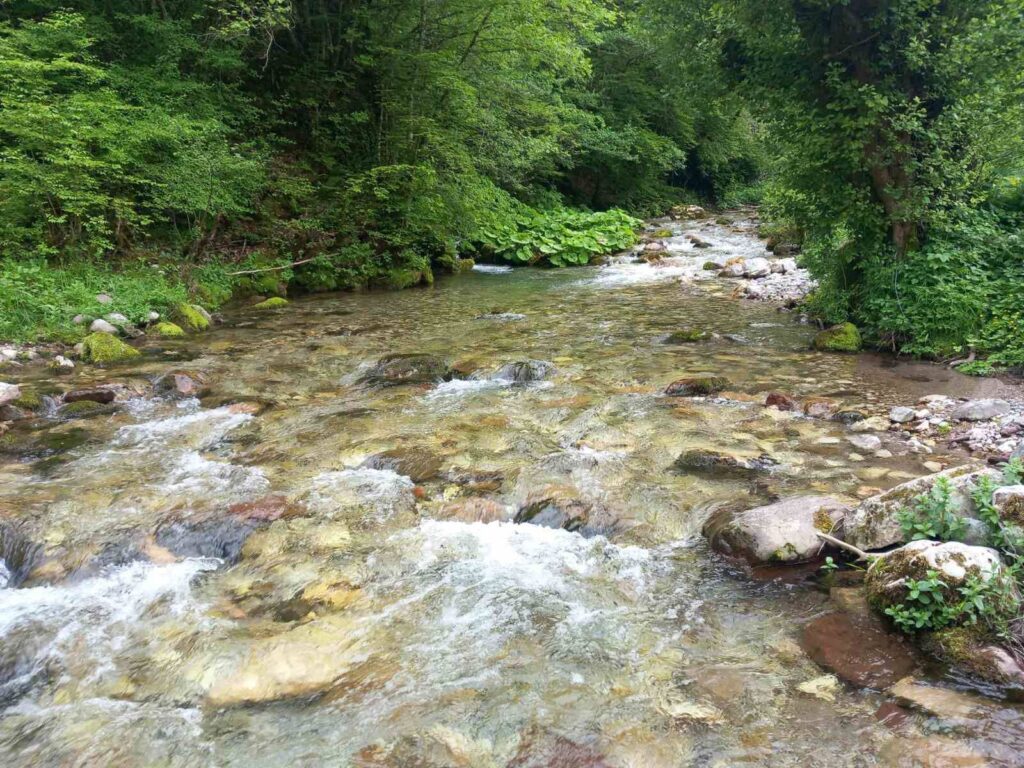
The Ministry of Spatial Planning, Construction, and Ecology of the Republic of Srpska has rejected the request submitted by the company “Srbinjeputevi” d.o.o. Foča for approval of an Environmental Impact Study for the construction of the small hydropower plant “Bjelava.” This decision is one in a series of victories for the citizens who have been fighting against this harmful project for the past five years.
“This is the crowning achievement of our years-long struggle and proof that the arguments and the truth are on the side of the people and the public. From the very beginning of the construction, we pointed out numerous irregularities — from works being carried out without permits, unresolved property issues, to the developer’s recklessness toward the environment and the municipal water supply,” said Miloš Vujičić, local resident and president of the citizens’ association “Bjelava.”
The study was rejected for several reasons, including: the planned pipeline of the SHPP runs through the sanitary protection zone of the “Lučka vrela” spring, the main supplier of drinking water for Foča; the impact of the project on the safety of the water supply was not analyzed; and the investor failed to submit the amended study even after an extended deadline, confirming that the project could threaten the environment.
“We are grateful to all fellow citizens who recognized the importance of our response and who supported and legitimized our fight with their signatures. We are also thankful to responsible individuals in local and republic institutions, such as JKP Izvor, the Municipality of Foča, the RS Inspectorate, Vode Srpske, MPUGE, and MER, who contributed to saving the Bjelava River and the town’s water supply through their dedicated work. We hope that RS institutions, respecting the law and the will of the people, will bring this issue to a final close by permanently removing SHPP Bjelava from all plans and contracts. We also hope to receive the necessary support to return the Bjelava River to its original course and to repair the damage caused by road construction, blasting, illegal logging, and landslides,” Vujičić said.
Comments on the Environmental Impact Study, which formed the basis of the Ministry’s decision, were submitted by activists and citizens gathered in the “Bjelava” citizens’ association from Foča, the Center for Environment — which has led the legal battle from the beginning — as well as other organizations from Bosnia and Herzegovina.
“What matters most is that this area has been defended. In many cases, it has been shown that small hydropower plants cause enormous damage to nature and local communities, benefiting only a few individuals. The river is devastated, concession fees are minimal, the electricity is exported by private companies, and any chance for better, more sustainable development in the area is lost,” said Vladimir Topić, program coordinator for Energy and Climate Change at the Center for Environment.
This project has been marred by numerous controversies and irregularities from the start, causing harm to the Bjelava River, the environment, the municipal water supply, and private property in Foča. However, instead of terminating the controversial concession agreement, the Government of the Republic of Srpska indicated it would allow the investor to continue the disputed project and announced the signing of a new, second annex to the contract. During the public hearing held in March 2024 in Foča regarding the Draft Environmental Impact Study, citizens clearly stated: “We will never give up, we will not give Bjelava nor our drinking water to the investor. What is ours stays ours!”
“We now expect the Ministry of Energy and Mining of the Republic of Srpska to terminate the concession agreement, which is flawed on many grounds,” Topić added.
It should be noted that, after three administrative disputes, the Center for Environment received court confirmation that the reasons for their lawsuits could also serve as grounds for considering the termination of the concession agreement for the construction and use of this project, which was signed in 2019 between the investor and the Government of the Republic of Srpska.

The 2019 concession agreement clearly defined deadlines for implementing the project in two phases: 12 months for preparatory works and 24 months for construction and commissioning of the plant. Additional deadlines, approved in the first annex to the agreement in 2021, expired back in 2022. Importantly, the relevant ministry has already confirmed that signing an additional annex to this project would be legally uncertain.
“In such a situation, maintaining a legally uncertain concession relationship is harmful, and the Government must consider terminating the concession agreement. The conditions for termination are outlined both in the law and in the agreement itself — the conceding authority can unilaterally terminate the contract if the concessionaire fails or neglects to perform the required actions within the agreed timeframe or, through its own fault, fails to commence the concession activity within the agreed timeframe,” explained Redžib Skomorac, legal advisor at the Center for Environment.
“In addition to delays in project implementation — which in itself carries legal consequences — we remind that the investor was previously convicted of a criminal offense related to obtaining this concession. Therefore, ending the concession relationship is not only a legal obligation for the conceding authority, but also a morally justified act that the wider public rightfully expects,” Skomorac concluded.