
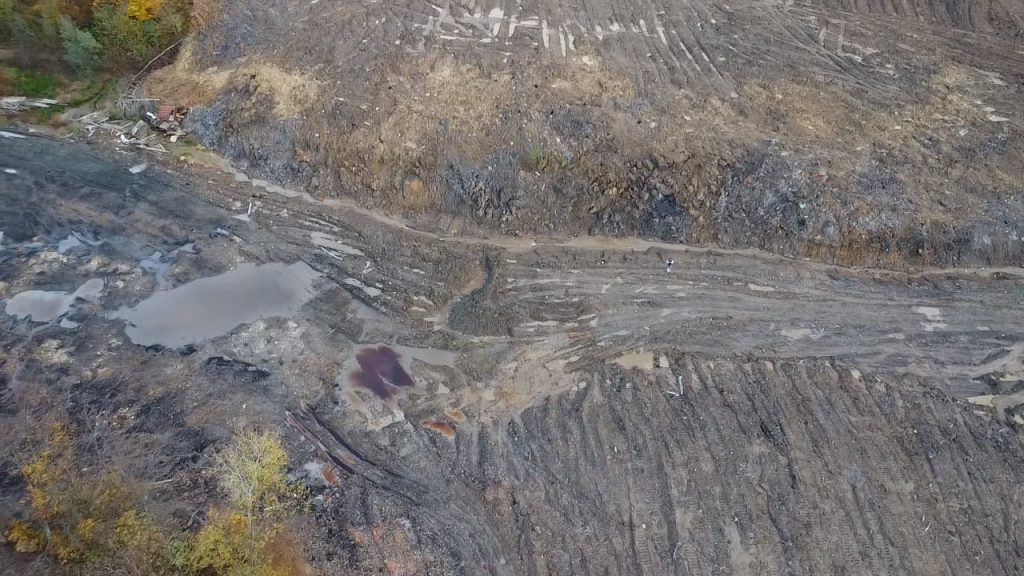
In recent years, Bosnia and Herzegovina has become a true mining colony, from which tens of millions of tons of coal have been extracted — with just as much waiting to be hauled away. In addition to environmental pollution, what remains behind the mines are mostly barren and devastated lands that urgently need remediation and reclamation. However, the reality is quite different.
By: Dragan Maksimović
Coal exploitation in BiH intensified a few years ago, right after the war in Ukraine, when the global price of coal began to rise uncontrollably. Under such conditions, BiH became a hotspot for coal extraction — particularly for companies from Serbia, most of them connected to authorities in Belgrade. The first on the list was Medna, a coal mine in the village of the same name, which initially lacked all the necessary permits. The residents of this area near Mrkonjić Grad mostly moved away. Then followed others — Bistrica and Bukova Kosa near Prijedor, Kamengrad near Sanski Most, and many more, some of which have already closed, like the one in Medna, where the deposits were exhausted.
The resistance from local communities living near planned or existing mines is strong but yields little concrete result — meaning neither respect for environmental standards nor adequate reaction from competent inspections to prevent threats to people’s lives and health.
More a rule than an exception
So far, practice has shown that a number of laws and regulations are violated during mining operations, leading to soil, water, and air contamination. Beyond pollution, the main issue arises once mining ends — when the land is not rehabilitated or restored to its intended use. The failure to carry out remediation and reclamation is more the rule than the exception. The lack of stricter regulations, along with inadequate or entirely absent implementation of existing laws, enables mining concessions and exploitation to be granted quickly, with little concern for environmental or other standards.
The law requires that, after exploitation ends, remediation and reclamation measures be implemented to restore the degraded area. These activities include terrain rehabilitation, soil stabilization, removal of hazardous materials, and re-establishment of functional land use — all according to previously approved plans from the competent authorities.
However, studies by Center for Environment BiH, carried out within the analysis of possibilities for remediation and reclamation of coal mines across the country, show that the implementation of these legal requirements is extremely poor.
This situation is largely the result of weak institutions, insufficient oversight, and constant clashes between public interest and political or economic pressures. Although the legal framework clearly defines investors’ obligations after mining ends — including preparing and executing remediation projects, monitoring, and restoring land to an acceptable condition — in practice, these provisions are bypassed, selectively interpreted, or ignored. Investors, driven by profit, avoid fulfilling these duties, as they require significant financial investment — especially once the mine stops generating revenue.
On the other hand, the authorities responsible for oversight and sanctions often fail to act due to political influence and corruption, the Center’s study notes.
Bistrica’s nightmare
Perhaps the best example is the Bistrica mine near Prijedor, whose opening was marked by controversy, as the investor did not possess all the necessary permits. It later became a nightmare for the residents of this Kozara foothill village.
In Bistrica, there is no asphalted or concreted area designated for parking and maintaining machinery. Oil and fuel stains are visible throughout the mine, and some machines — left broken down — remain scattered on site. There is visible pollution from smaller items such as chains, machine parts, construction debris, and more.
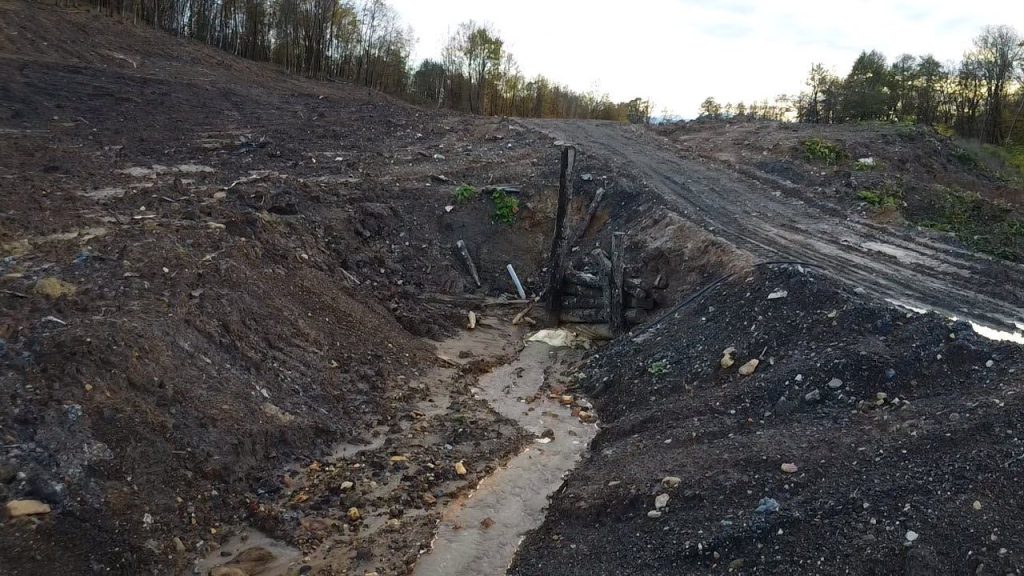
Heaps of tailings cover the entire mine, with no traces of topsoil. The waste material is mixed with coal residue, and on the western side of the mine, a large active landslide — caused by excavation — is clearly visible.
The nearby Crljenjača River is also in poor condition, with its water muddy even during dry periods when no mining is taking place. The riverbed has been diverted, though it’s unclear whether this was done according to approved documentation.
“I graduated from the Faculty of Mining, but I was never taught that reclamation and remediation should be done like this,” says Danijel Lazić from Bistrica, confirming that coal extraction has stopped but no land restoration has been carried out.
“They undermined people’s land, and the court ruled that the mine was not guilty. And now we’re supposed to expect someone to restore the land to its original condition? This isn’t a state — this is nothing. This is a parody,” says Lazić, continuing breathlessly:
“Not only has there been no reclamation — we don’t even have water anymore. The old water pipes are hanging in the air, and no one comes, no one reacts. No government, no inspections — nothing.”
Written on paper, broken in practice
In Bistrica, a reclamation project exists — on paper — consisting of two phases. The first, technical phase, involves backfilling the mining terraces with tailings, followed by leveling and spreading humus across the excavation and dumping areas. The second, biological phase, starts with fertilizing the surface before sowing — planting a mix of grasses and then compacting the terrain.
A field inspection makes it clear that none of this has been implemented, according to the analysis of current conditions in BiH.
When it comes to private mines, ownership often includes the land itself. Private owners usually lack financial motivation to carry out reclamation, especially since the process serves the broader public good. These efforts also require ongoing maintenance, which private entities have no interest in. For that reason, the report suggests developing a mechanism to transfer such land into public ownership.
As for companies with state-granted coal concessions, their standard response is that reclamation will be carried out “as planned.” However, a legal loophole emerges here: concessions are granted for 20–30 years, while extraction may end within 2–5 years, and the mine remains officially “open.” This leaves enormous room for abuse.
Thirty-year concessions, zero activity
“If the land hasn’t been reclaimed, it would be fair to give it to someone willing to do it. But the fact is, mines remain open on paper — even after 30 years — despite extraction being long finished,” says Damir Miljević from the Center for Sustainable Energy Transition RESET.
Denis Žiško, energy and climate program coordinator at the Aarhus Center in Sarajevo, adds that very few open-pit mines in BiH have completed the formal closure process. “What’s being pushed now under the guise of ‘energy transition’ is really just an attempt to extract more money through solar panel projects,” he says.
“First, you need a spatial plan, then an environmental permit for reclamation, and only then can you start. Now, BiH power companies are rushing to install solar panels without following the rules,” Žiško continues, emphasizing that the idea of repurposing these areas for solar use is good — as it would prevent panels from spreading onto farmland.
“Many mines closed 10–20 years ago were never officially shut down because reclamation was never done. Some were abandoned 30 years ago, and nature simply reclaimed them,” Žiško adds.
Lessons from elsewhere
Around the world, former mines have been successfully transformed into lakes, botanical gardens, forests, solar farms, recreation areas, and museums.
A striking example is Canada’s Butchart Gardens, once a limestone quarry, now a world-renowned botanical attraction with over a million visitors annually. In Germany, Landschaftspark Duisburg-Nord turned a former steelworks complex into an adventure park.
In the Balkans, such examples are rare. One exception in BiH is Lake Radovan near Novi Travnik — a former iron mine that naturally transformed into a lake, now used for diving, swimming, and recreation.
Poland’s Wieliczka Salt Mine, a UNESCO World Heritage site, combines preserved mining chambers with museums and concert halls. In Wales, the Big Pit National Coal Museum, also a UNESCO site, remains intact as an authentic experience of life underground, fully funded by the government. Similarly, in Croatia, the Labin Mining Museum preserves a former coal mine as a cultural heritage site.
“No dust”
Despite the regulations, BiH still lacks an effective mechanism for enforcing reclamation. Mines are often abandoned without any rehabilitation measures, leading to soil and water contamination, unstable terrain, and loss of biodiversity. Global examples show that revitalization can succeed if based on long-term planning, community involvement, and innovative approaches — from turning mines into lakes or solar farms to creating cultural or agricultural spaces.
Perhaps the current system in BiH is best illustrated by the work of inspection bodies and local “sheriffs,” whom Denis Žiško sees as the main enablers of this dysfunctional system.
“We’ve filed countless reports to inspections, and the official records are laughable — I’d be ashamed to sign them,” says Žiško, recalling a report about a slag dump in Tuzla.
“In the report, the responsible person claimed to ‘doubt the authenticity’ of the video we provided because, at the time of inspection, there was no dust visible. And that’s where the story ends,” Žiško says, illustrating the absurdity of the entire system.
This article was produced in cooperation with Center for Environment as part of the campaign “Stop Dirty Energy, The Future is Renewable!”